 MoneyUnder40
The Two-Account System: The Simplest Way to Organise Your Money
You know the feeling. Payday lands, the balance looks healthy, and then — somehow, by the 20th — you are checking your account before buying groceries, wondering where it all went.
It did not go anywhere mysterious. It went to the same place it always goes: the blurry middle, where bill money and spending money live in one account and you cannot tell them apart until it is too late.
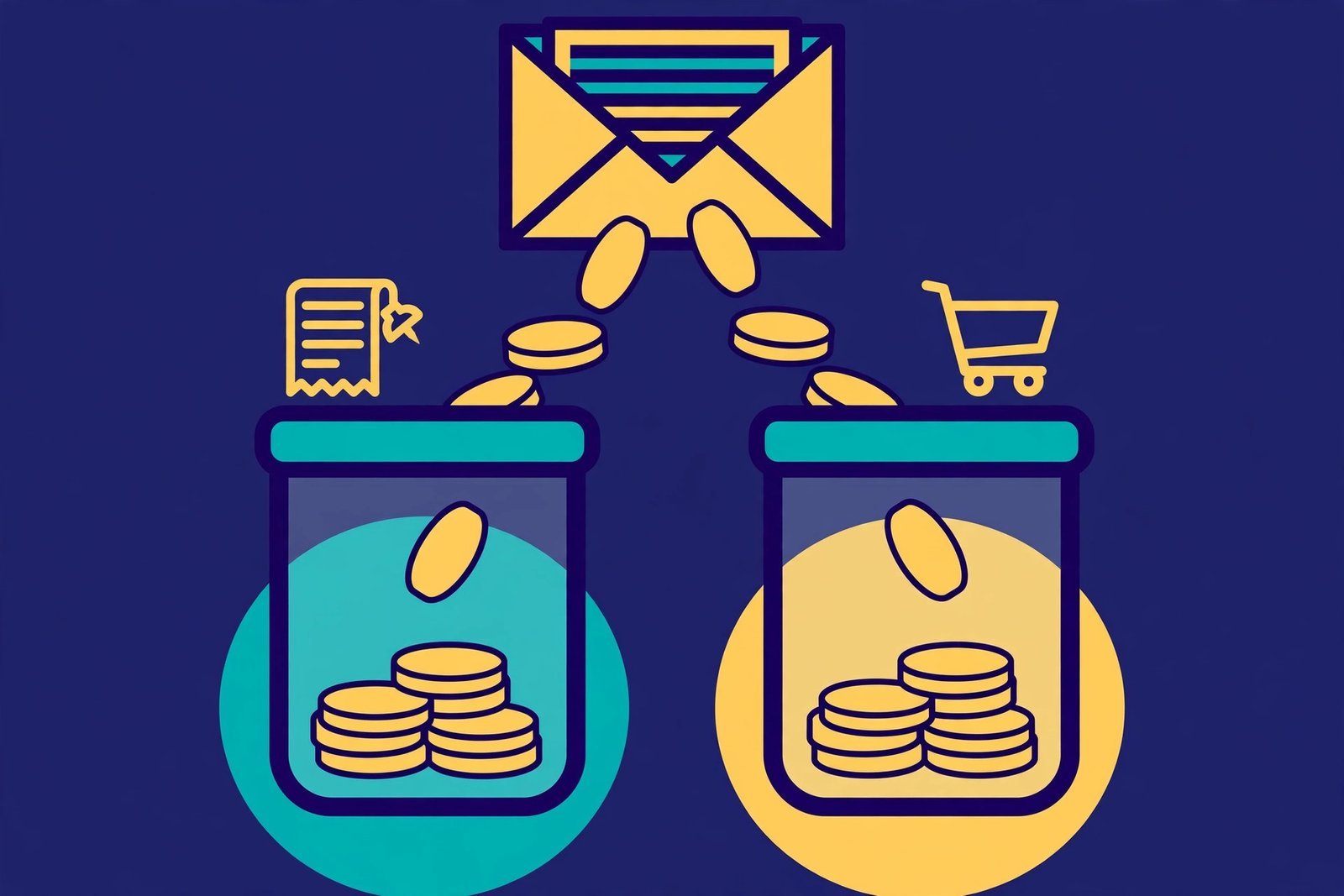
The two-account system fixes that with one simple move: split your money into two accounts with two jobs. Bills live in one. Spending lives in the other. When the spending account is empty, you stop — not because you ran out of money, but because you spent exactly what you planned to spend. The bills are safe in the other account, untouched.
That is the whole system. No app, no spreadsheet, no willpower required after setup day.
How it works
Account 1: Bills. This is where your paycheck lands first. Rent, utilities, insurance, phone, subscriptions, loan payments, and your savings transfer all come out of this account. It is the serious account. You do not carry its card around, and you do not browse with it.
Account 2: Spending. This is your everyday account. Groceries, fuel, takeout, fun, clothes — everything you choose day to day. Once a week or once a payday, you move a fixed amount from Bills to Spending. That amount is your spending budget, and when it is gone, it is gone until the next transfer.
The magic is psychological, not mathematical. With one account, every purchase is a guess: “Can I afford this, given the bills still to come?” With two accounts, the question answers itself: “Is there money in Spending? Then yes. Is it empty? Then not this week.” Decisions get faster, guilt gets smaller, and bills never get ambushed by a good weekend.
Money tip: The Bills account should hold a one-month buffer eventually — one month of bills sitting there at all times — so a late paycheck or a surprise never turns into a missed payment. Build it gradually; it is the system’s shock absorber.
The worked example: $4,200 a month
Take Maya, who brings home $4,200 a month, paid twice monthly at $2,100 per paycheck. Here is her two-account setup:
Bills account (per month):
| Outgoing | Amount |
|---|---|
| Rent | $1,400 |
| Utilities + internet | $220 |
| Insurance + phone | $280 |
| Car payment | $300 |
| Subscriptions | $60 |
| Savings transfer (pay yourself first) | $420 |
| Bills total | $2,680 |
Spending account (per month):
| Category | Amount |
|---|---|
| Groceries | $500 |
| Fuel + transport | $300 |
| Takeout + dining | $280 |
| Fun + personal | $240 |
| Household + misc | $200 |
| Spending total | $1,520 |
Check it: $2,680 + $1,520 = $4,200. Every dollar has a job, and the split is visible at a glance.
Per paycheck, the mechanics are simple: $2,100 lands in Bills, the bills and the $210 savings transfer (half of $420) go out, and $760 moves to Spending. Maya’s everyday card is linked to Spending only. If Spending hits zero on the 24th, she eats from the pantry for a week — she does not touch rent money, because rent money is not in that account.
Notice the savings line: $420 a month is 10% of take-home, moved before spending starts. That is pay yourself first built into the system rather than bolted on afterwards. If you have not set up payday automation yet, our automation guide shows the exact steps.
Try it: split your paycheck
Setting it up in an afternoon
Step 1: Open the second account
You need two checking accounts — or one checking and one savings-style account for bills, if your bank allows bill payments from it. Most banks let you open a second checking account in minutes online, often with no extra fee. If your bank charges for a second account, a free online bank or credit union account works just as well. Keep both at institutions you trust, and make sure both are insured — FDIC for banks, NCUA for credit unions.
Step 2: List your real bills
Go through three months of statements and list every fixed outgoing: rent, utilities, insurance, phone, subscriptions, minimum debt payments. Add them up. That total is what Bills must cover each month. If you use a zero-based budget, this is the same exercise — the two-account system is just the plumbing that makes the budget run itself.
Step 3: Decide the spending transfer
Spending = take-home pay − bills − savings. Be honest here: if the number comes out lower than you hoped, that is information, not failure. A spending transfer you can actually live on beats an ambitious one you blow through in week two and then abandon.
Step 4: Automate the transfer
Set a recurring transfer from Bills to Spending on payday — or the day after, so bills clear first. Weekly transfers give tighter control; payday transfers are simpler. Pick one and automate it. The system only works if the transfer happens without you thinking about it.
Step 5: Point your cards at Spending
Your everyday debit card, your digital wallet, your grocery spending — all linked to Spending. The Bills card stays home. This is the step people skip, and it is the step that makes the whole thing work: if your everyday card can reach bill money, you still have one account with extra steps.
What about irregular income?
If your pay varies, the system still works — you just run it in reverse order of certainty. Keep the bills buffer bigger: aim for two months of bills in the Bills account, not one. In good months, top the buffer up first. In lean months, the buffer covers bills while Spending shrinks to essentials. The spending transfer becomes a percentage of what actually landed, not a fixed number: for example, move 35% of each payment received into Spending and leave the rest for bills and savings until the buffer is full. Freelancers can pair this with the approach in How to Budget on an Irregular Income.
The savings upgrade
Once the two accounts are running smoothly, add a third job without adding complexity: keep your savings transfer inside Bills, but point it at a high-yield savings account instead of your everyday bank. The FDIC average savings rate is 0.38%, while top high-yield accounts pay around 4–5% APY. On a $5,000 emergency fund, that is roughly $19 a year versus $200–$250 a year — for money that was going to sit there anyway. The two-account system gets your savings moving; the high-yield account makes them work while they wait.
Mistakes that break the system
Keeping both cards in your wallet. If the Bills card is one tap away, the boundary is imaginary. Leave it at home.
Setting the spending transfer too high. A transfer that leaves bills short is not generous — it is a system that fails on the 28th. Start conservative, then raise it once bills are covered with room to spare.
Forgetting annual bills. Car registration, annual subscriptions, insurance renewals — the bills that arrive once a year and wreck a month. Add a monthly sinking-fund line inside Bills for them: divide each annual cost by 12 and set it aside monthly. Our guide to 9 budget categories most people forget lists the usual suspects.
Raiding Bills for "just this once." Every raid teaches you the boundary is negotiable. If Spending is empty and the purchase matters, wait for the next transfer — or move money deliberately, in the open, and adjust next month's transfer to repay it.
Running it for a week and quitting. The first month feels clumsy. The second month feels obvious. Give it two full pay cycles before judging it.
Frequently asked questions
Do I need a second bank, or just a second account?
Either works. Two accounts at the same bank are simplest to manage. A second bank adds friction — which some people want, because it makes raiding Bills harder. Choose based on your own discipline, not someone else's.
What if my bills are more than my income?
Then no system fixes the gap by itself — but the two-account system makes the gap visible fast, which is the first step. List bills honestly, cut or renegotiate the biggest ones, and look at income options. A system that shows you the problem in week one beats one that hides it until the overdraft fee arrives.
Should savings live in Bills or its own account?
Savings starts inside Bills as a transfer line, but it should land in a separate savings account — ideally high-yield. Bills is for money going out; savings is for money staying put.
Bottom Line
Here is my stance: most budgeting advice fails because it asks you to make good decisions fifty times a month. The two-account system asks you to make one good decision — the split — and then lets the accounts make the rest for you.
Open the second account this week. List your bills, set the spending transfer, automate it, and point your everyday card at Spending. Within two pay cycles, "where did my money go?" stops being a mystery, because the answer is sitting in two balances you can read at a glance. Bills are covered. Spending is bounded. And the money in between finally has a job.