 MoneyUnder40
Stocks vs Bonds for Beginners: What Actually Goes Where
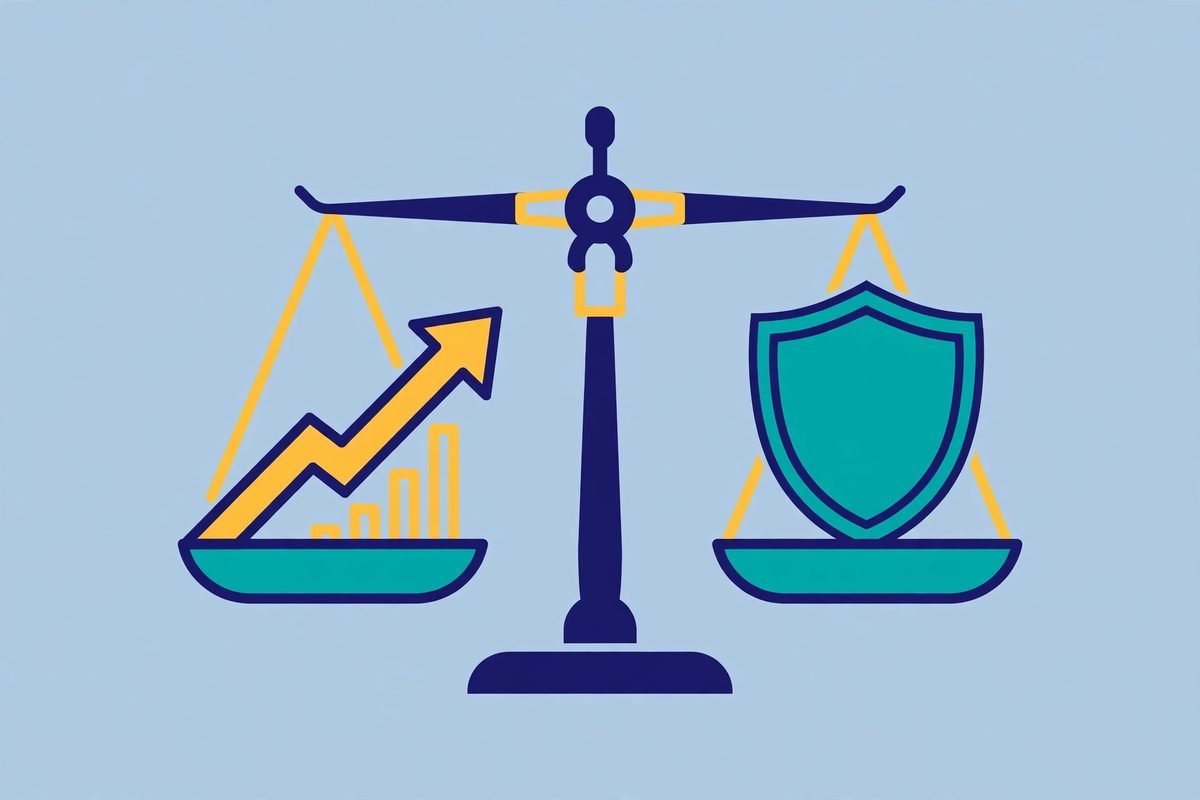
You open an investment account, ready to start, and it asks a question that sounds simple and feels impossible: how much in stocks, and how much in bonds?
Here is the honest truth most beginners never hear: there is no single correct answer, and anyone selling you one is guessing about your life. What you need is a way to decide for yourself — based on when you need the money, and how much bouncing around you can live with while you wait.
Stocks and bonds are not rivals. They do different jobs, and once you understand those jobs, the split stops feeling like a test and starts feeling like a plan.
What Stocks Actually Are
When you buy a stock, you buy a small piece of a company. If the company grows, your piece can become worth more; if it struggles, your piece can fall. You are along for the ride, in both directions.
That is why stocks are the growth engine of most long-term portfolios. They offer the chance for your money to grow faster than cash, but the ride is bumpy — prices move up and down, sometimes sharply, and nobody can tell you in advance which years will be smooth.
Money tip: Think of stocks as the part of your money working hardest — and complaining loudest. You want that energy for far-away goals, because time gives the bumps a chance to even out.
What Bonds Actually Are
A bond is, in plain language, a loan you make. You lend money — usually to a government or a company — and in return you get regular interest payments, plus your original money back when the bond matures, assuming the borrower pays as promised.
Bonds do not usually grow the way stocks can. Their job is steadiness and income: when stocks fall, bonds often fall less, which can make your whole portfolio feel calmer. That calm has real value, especially when you need the money soon or when drops tempt you to sell everything in a panic. Bonds are not risk-free, and their prices can move too — but their role is generally the steadier one.
How They Behave Differently
The easiest way to see the difference is side by side:
| Stocks | Bonds | |
|---|---|---|
| Main job | Growth over the long term | Steadiness and regular income |
| How it feels | Bumpy — bigger ups and downs | Calmer — smaller moves, generally |
| Best for | Money you will not need for many years | Money you will need sooner, or money you want to keep steady |
| The risk | Value can fall sharply for a while | Value can still move, and returns are usually more modest |
Neither column is “better.” Only stocks might grow more over decades, but it will test your nerves. Only bonds might feel peaceful, but it may not grow enough for a goal thirty years away. Most beginners land somewhere in between — and that in-between is a feature, not a failure to decide.
How to Choose Your Mix
Start with your timeline, because it matters more than any personality quiz.
Money you need in the next year or two should not ride the stock market’s ups and downs. Money you will not touch for twenty or thirty years, like retirement savings, has time to recover from drops, so it can carry more stocks.
Next, be honest about your stomach for volatility. Some people can watch their account drop and keep investing calmly; others lose sleep, stop contributing, or sell at the worst moment. A mix you can actually stick with beats a theoretically perfect mix you abandon in the first bad year. The best portfolio is the one you keep funding.
The “110 minus your age” rule of thumb
You may hear a rough rule of thumb: subtract your age from 110, and the result is a rough starting point for the percentage in stocks. So at age 30, that rule of thumb would suggest around 80% stocks and 20% bonds. At age 50, it would suggest around 60% stocks and 40% bonds.
Treat that exactly as what it is: a rough rule of thumb, not a recommendation, and not advice for your situation. Your timeline, your other savings, your job stability, and how you react to market drops all matter more than any formula. If the rule’s answer feels wrong for your life, trust your life over the rule.
A younger investor with decades until retirement often leans toward stocks, because there is more time to ride out the bumps. Someone closer to needing the money often leans toward bonds, because steadiness starts to matter more than maximum growth.
Where Beginners Actually Hold Them
Most beginners hold them inside accounts designed for the goal, often through diversified funds bundling many stocks or bonds.
A 401(k) is a workplace retirement account, if your employer offers one. You contribute from your paycheck, often into a selection of funds, and the money is meant for retirement. For 2026, the elective deferral limit is $24,500, according to IRS Notice 2025-67. That is a limit, not a target — contributing something regularly matters far more than hitting the maximum.
An IRA is an individual retirement account you open yourself, separate from any employer. For 2026, the IRA contribution limit is $7,500, plus a $1,100 catch-up contribution if you are age 50 or older, also according to IRS Notice 2025-67. For a small, realistic first step, see this guide to starting a Roth IRA in your 20s with $50.
A brokerage account is a general investment account, not tied to retirement. You can use it for goals beyond retirement, with more flexibility about when you withdraw — which also means no retirement-account structure nudges you to leave the money alone, so your own plan has to do that job.
Inside any of these accounts, beginners often use index funds, which hold a broad basket of stocks or bonds rather than betting on one company. If that idea is new to you, start with this beginner guide to index funds and your first $100. On fees: as one example, the fund VOO has an expense ratio of 0.03%, or $3 per year for every $10,000 invested, as verified on the fund’s site on October 20, 2026. That is one fund’s fee, not a standard — always check any fund’s own expense ratio before you invest.
What Growth Can Look Like Over Time
Small, regular contributions add up slowly, then faster, because growth builds on growth. The illustrations below are illustrations, not predictions or guarantees, and real returns will differ.
Put in $100 a month for 30 years — $36,100 deposited in total. Illustrated at 7%, not a prediction or guarantee, that could grow to about $122,800 in total. Illustrated at 4%, not a prediction or guarantee, the same $100 a month could total about $69,400 on the same $36,100 deposited.
Try it: project your savings growth
The gap between those illustrations is the whole story: a few percentage points, repeated over decades, matter enormously. So does starting — the $36,100 deposited is the part you control.
For benchmarks to check yourself against, see this guide to how much you should have saved by 30, 35, and 40.
Common Mistakes Beginners Make
Putting everything in stocks because growth sounds better. Growth only helps if you stay invested long enough to get it. If a sharp drop makes you sell, you lock in the loss and miss the recovery. Bonds help you stay in the game.
Putting everything in bonds because safety sounds better. For a goal thirty years away, too much caution has its own cost: your money may not grow enough to do the job you saved it for.
Changing your mix every time the news worries you. Your mix should change because your life changed — you got closer to the goal, or your timeline shifted — not because of one bad week.
Chasing whatever did best last year. Last year’s winner is not a plan. A steady mix, funded regularly, beats a portfolio rebuilt around yesterday’s headlines.
Ignoring fees. A fund’s expense ratio is one cost you can check in minutes — check any fund’s own ratio rather than assuming it matches an example you read somewhere.
Waiting until you understand everything. A simple mix, in an account that fits your goal, funded regularly, beats another year of research.
Frequently Asked Questions
Do I need both stocks and bonds?
Not necessarily, but most beginners benefit from both: stocks bring growth potential, bonds bring steadiness. Your timeline and tolerance for ups and downs decide the balance, not a rule that applies to everyone.
Is the “110 minus your age” rule a recommendation?
No. It is a rough rule of thumb some people use as a starting point. It does not know your timeline, your other savings, or how you react to drops. Use it to start a conversation with yourself, not to finish one.
What if I can only invest a small amount?
Then invest a small amount, regularly. The illustrations above start at $100 a month because small and steady is how most people actually build wealth. Consistency beats a large one-time contribution you never repeat.
Should I pick individual stocks instead of funds?
For most beginners, no. Picking individual stocks bets your outcome on a few companies and takes research most beginners do not have time to do well. Diversified funds spread that risk across many holdings — usually the calmer starting point.
The Bottom Line
Here is my stance, plainly: for money you will not need for decades, lean toward stocks — growth is the job that money has to do — and use bonds to stay steady enough to stay invested when the ride gets rough. For money you need soon, flip the priority: steadiness first, growth second.
Do not let the perfect mix become the reason you invest nothing. Pick a mix that fits your timeline, put it in an account that fits your goal, fund it regularly, and check any fund’s own fees before you buy. That unglamorous routine — not a brilliant stock pick — is what builds wealth over time.