 MoneyUnder40
Balance Transfer Cards: When the 0% Offer Actually Saves You Money
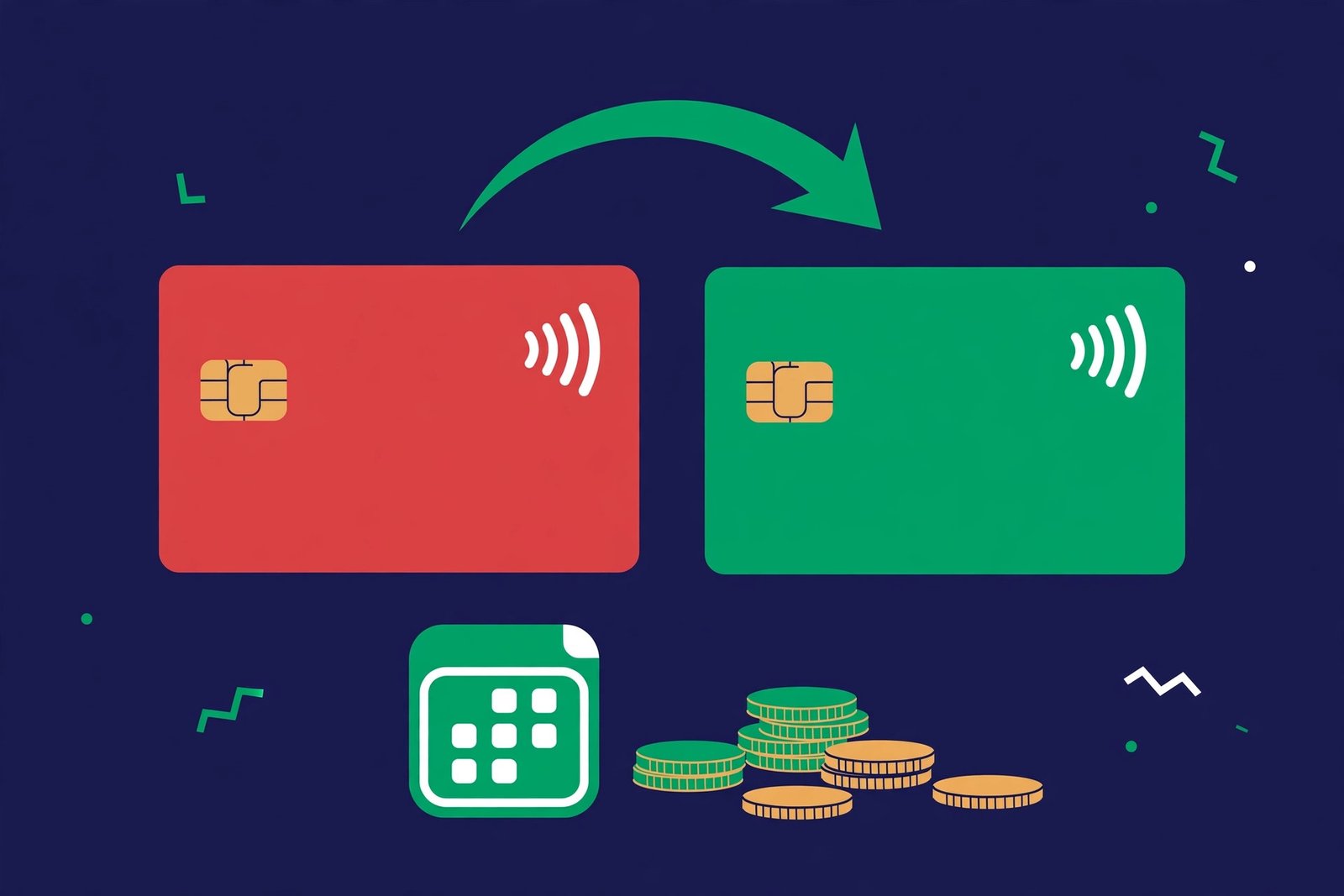
The average credit card charges 19.71% interest. A balance transfer card charges 0% for up to 21 months. The gap between those two numbers is worth about $988 on a $5,000 balance — if you play it right.
The 19.71% is Bankrate's weekly national survey of large banks and thrifts, updated November 4, 2026 — down from the record 20.79% set in August 2024, but still nearly a fifth of the balance every year. And that is the average across all cardholders. The Federal Reserve's G.19 release of November 6, 2026 puts the rate actually paid by accounts assessed interest at 22.36% in the third quarter of 2026. Revolving consumer credit stood at $1,368.5 billion in September 2026, and Morningstar reported in October 2026 that 177 million Americans are carrying a credit-card balance. If you are one of them, the 0% offer is not a gimmick. It is the cheapest money you will be offered all year — with conditions attached.
"A 0% balance-transfer card is about the best weapon that you have in the fight against credit-card debt. If you can go nearly two years without accruing any interest on a balance, which a lot of cards out there today let you do, it's a complete no-brainer," says Matt Schulz, Chief Consumer Finance Analyst at LendingTree, in MarketWatch via Morningstar on October 30, 2026. He is right — with one word doing a lot of work: "if".
The two numbers that decide everything
A balance transfer moves debt from a card charging interest to a card charging 0% for a set period. The longest offers in November 2026 run 21 months: the Citi Diamond Preferred and Citi Simplicity, the Wells Fargo Reflect, the BankAmericard, the U.S. Bank Shield Visa, and the relaunched Chase Slate all offer 21 months on balance transfers. Most other cards offer 12 to 18 months.
The transfer is not free. The standard fee in 2026 is 3% to 5% of the amount moved. Citi charges 3% on transfers completed within the first four months of account opening, then 5%. Wells Fargo Reflect and BankAmericard charge 5% flat. A few credit-union cards charge nothing, usually with a shorter 0% window. And you need the credit score to get in: CreditCards.com's November 2026 roundup puts the floor at 670 or higher on the FICO scale for competitive 0% offers, while NerdWallet, updated November 2, 2026, says 690 or better is where approvals realistically happen — its own 2024 applicant data showed an average score of 727 among approved applicants, with most approvals above 720.
The maths: when it saves you $988
Take a $5,000 balance at the Bankrate average of 19.71%. Move it to a Citi Diamond Preferred: 0% for 21 months, 3% fee if transferred within four months.
The fee is 3% of $5,000, or $150. Your new balance is $5,150. To clear it inside the 21-month window, you pay $5,150 divided by 21 — $245.24 a month. Total paid: $5,150. Interest paid: $0. The whole strategy costs the $150 fee.
Now run the same payment without the transfer. Paying $245.24 a month on $5,000 at 19.71% takes 26 months, not 21, and costs $6,138.47 in total — $1,138.47 of it interest. The transfer saves $988.47, about $988, and gets you debt-free five months sooner. With a 5% fee instead of 3%, the fee is $250, the monthly payment is $250.00, and the saving is still about $888.
One month of interest on $5,000 at 19.71% is $82.12. The 3% fee pays for itself in under two months. That is the whole case for the transfer in one line: the fee is small, the interest it kills is not.
Before you apply, run your own balance through the debt payoff calculator below — put in your real balance and APR, and see what the monthly payment has to be to clear it inside the 0% window. If that payment is one you can actually make, the transfer is a good bet.
Try it: which payoff strategy wins for you?
And when it doesn't work
Now run the same transfer a second time, with a smaller payment. Same $5,000 balance, same $150 fee, same $5,150 starting balance — but you pay only $150 a month.
Over 21 months you pay $3,150. When the 0% period ends, $2,000 is still sitting there — and it starts accruing interest at the card's regular variable APR. At the low end of Citi Diamond Preferred's range, 16.74%, clearing that $2,000 over twelve more months costs $182.11 a month, $2,186.01 in total, with $186.01 of it interest. The whole journey costs $5,336.01. At the high end, 27.49%, it costs $2,310.16 for that last stretch, and $5,460.16 in total.
Compare that with never transferring at all and paying the same $150 a month at 19.71%: 49 months, $7,301.29 in total, $2,301.29 of it interest. Even the "failed" transfer still saves about $1,965 against staying put at the low reversion rate. The transfer is forgiving. But the $186 to $310 of post-promo interest is the price of not finishing on time — and it is entirely avoidable if you set the payment on day one.
For scale, consider the minimum-payment trap. Paying only the minimum on $5,000 at 19.71% — using the standard interest-plus-1%-of-balance minimum formula — takes about 226 months, nearly 19 years, and $7,203.64 in interest. That is an illustrative calculation, not a quote from a lender, but it shows why "minimum" is not a plan.
Five ways a transfer bites back
The fee can beat the interest. A 5% fee on a small balance you would clear in a month or two costs more than the interest it saves. At a 22.36% APR, the breakeven on a 5% fee is about 2.7 months; at a 3% fee, about 1.6 months. If you can clear the debt in one or two months anyway, don't pay the fee.
New purchases lose their grace period. While a transferred balance sits on the card, new purchases typically start accruing interest from the transaction date — the grace period is gone unless you pay the entire balance, including the transfer, in full each month, which defeats the point of spreading payments. Do not use the transfer card for spending. Put it in a drawer.
A missed payment can end the 0% period. A late payment can trigger fees and jeopardise the promotional rate, and under CARD Act rules a payment more than 60 days late can trigger penalty pricing — penalty APRs near 30% on some cards. Set autopay for at least the minimum on day one.
You can't transfer within the same bank. You cannot move a balance between two cards from the same issuer — Chase to Chase, Citi to Citi. The transfer card has to come from a different bank than the card holding the debt.
Running the old card back up. The classic failure: transfer $5,000 off Card A, then recharge Card A. Eighteen months later you owe on both cards. Close the spending habit, not just the balance — cut the old card out of your wallet until the transfer is paid off.
The 60-day clock most people miss
The 0% rate does not wait for you. Most cards give you 60 to 120 days from account opening to make the transfer at the promotional rate: BankAmericard and U.S. Bank Shield allow 60 days, Citi allows four months, Wells Fargo Reflect allows 120 days. Miss the window and the transfer may still go through — at the card's regular APR instead of 0%.
And check whether the 0% covers purchases too, because it varies by card. Citi Diamond Preferred gives 0% for 21 months on balance transfers but only 12 months on purchases. Wells Fargo Reflect, BankAmericard, U.S. Bank Shield and the Chase Slate give 0% for 21 months on both. If the card you pick only covers transfers, every purchase on it accrues interest from day one — another reason to keep it in the drawer.
Is your score ready?
The best 21-month offers go to good-to-excellent credit. The floor is a FICO score of 670; realistically, NerdWallet's data says 690 or better, with most approvals above 720. If your score is below that, check it before you apply — a hard inquiry on a rejected application costs you a few points and gains you nothing. If your score is close, a month of paying down the balance and keeping utilisation under 30% can be the difference between the 21-month offer and a 12-month one. Our guide to improving your credit score in 6 months walks through exactly that.
"Any hike down the road only adds to the cost if you carry a balance. Don't wait on the Fed for relief," says Ana Staples, Bankrate credit-cards expert, in the same October 30, 2026 report. "Moving that debt to a 0% intro APR card or paying it down aggressively is the surest way to cut what you owe in interest." The Fed held rates at 3.75–4.00% in October and the market expects a December hike. Your card APR is not coming down to rescue you. The transfer is the rescue you arrange yourself.
Bottom Line
A balance transfer card is the best weapon against credit-card debt — but only if you finish the job inside the 0% window. On $5,000 at 19.71%, the transfer saves about $988 and five months, and even a half-finished transfer beats staying put. The deal fails in exactly three ways: you pay too little each month, you use the card for new spending, or you miss a payment. Set the payment at $245.24 on day one, put the card in a drawer, turn on autopay, and let the 21 months do the work. If you are carrying a balance and the transfer is not right for you — your score is short, or the balance is small — the snowball vs avalanche method is the next best plan, and how credit card interest actually works shows you exactly what the interest is costing you while you decide.
Sources
- Bankrate, "Current Credit Card Interest Rates," updated 4 November 2026. Average APR 19.71% (4 November 2026); record 20.79% (14 August 2024). https://www.bankrate.com/credit-cards/advice/current-interest-rates/
- Federal Reserve Board, G.19 Consumer Credit statistical release, released 6 November 2026. Revolving credit $1,368.5 billion (September 2026, seasonally adjusted); accounts assessed interest 22.36%, all accounts 21.19%. https://www.federalreserve.gov/releases/g19/current/
- Morningstar (MarketWatch), Genna Contino, "This credit card is the 'best weapon' to fight debt while interest rates keep climbing," 30 October 2026. Verbatim Matt Schulz (LendingTree) and Ana Staples (Bankrate) quotes; 177 million Americans carrying a balance; 3%–5% transfer fees. https://www.morningstar.com/news/marketwatch/20261030105/this-credit-card-is-the-best-weapon-to-fight-debt-while-interest-rates-keep-climbing
- Bankrate, "Best Balance Transfer Cards of November 2026," updated November 2026. https://www.bankrate.com/credit-cards/balance-transfer/best-balance-transfer-cards/
- Motley Fool, "BankAmericard vs. Citi Diamond Preferred: Which Intro APR Card Wins in November 2026?" November 2026. https://www.fool.com/money/credit-cards/articles/bankamericard-vs-citi-diamond-preferred-which-intro-apr-card-wins-in-november-2026/
- NerdWallet, "Best Balance Transfer Credit Cards of November 2026," last updated 2 November 2026. https://www.nerdwallet.com/credit-cards/best/balance-transfer
- CreditCards.com, "Best Balance Transfer Credit Cards of November 2026," November 2026. https://www.creditcards.com/balance-transfer/
- LegalClarity, "What Does 0% APR on Balance Transfers Mean & How It Works" and "What Happens When You Transfer a Credit Card Balance?" (2026). https://legalclarity.org/what-does-0-apr-on-balance-transfers-mean-how-it-works/
- GetCentWise, "Balance Transfer Cards: A Beginner's Guide," updated 16 October 2026. https://getcentwise.com/credit-debt/balance-transfer-cards-beginners-guide/