
If you have ever downloaded a budgeting app, tracked every coffee for two weeks, and then quietly given up, you are not bad with money. You are just using a system that was never built for you.
Traditional budgeting asks you to sort your life into categories and watch each one. For some people, that structure is satisfying. For many others, it is exhausting — and an exhausting system is one you will abandon.
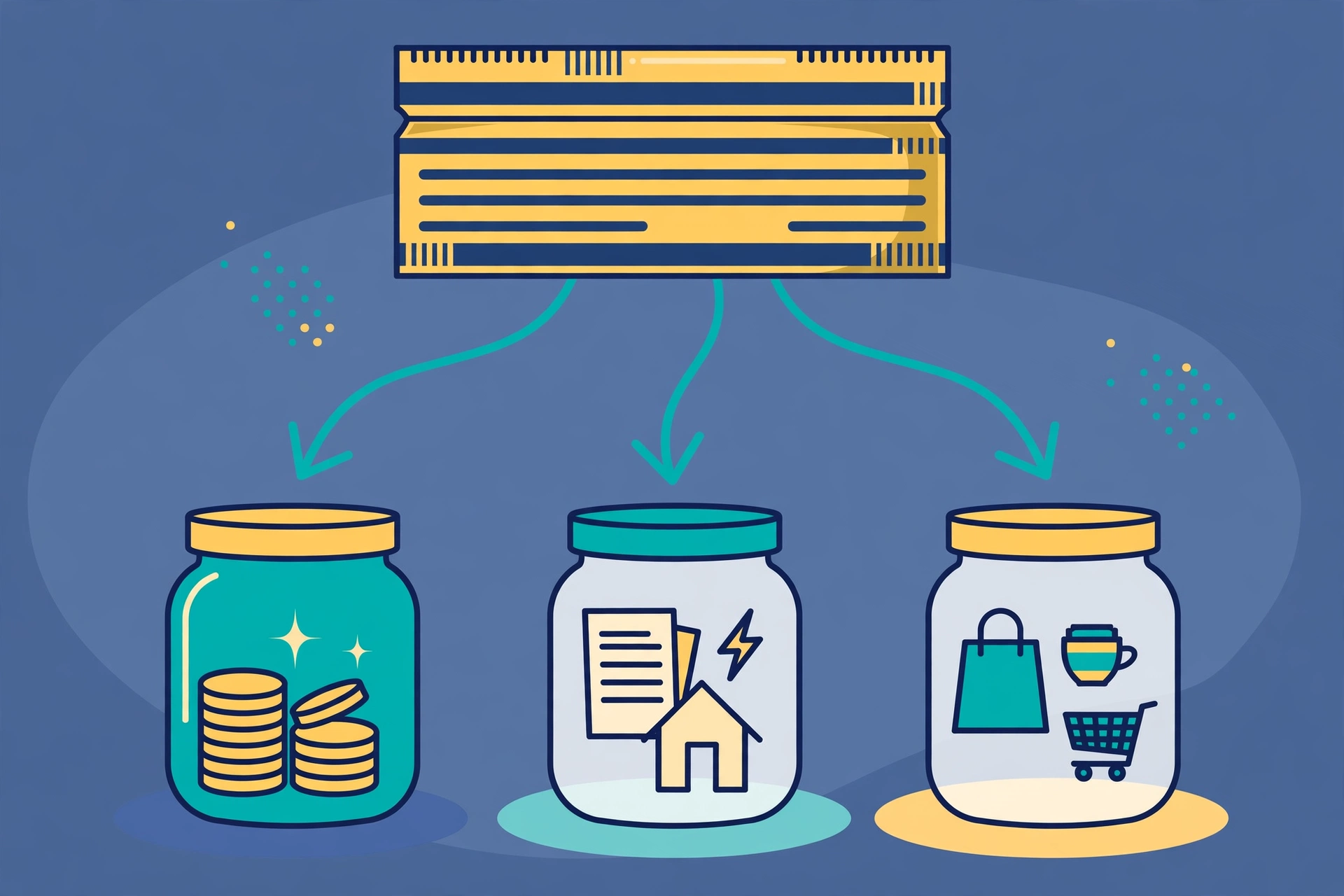
The anti-budget takes the whole idea and flips it around. Instead of tracking what you spend, you decide what you save and what your bills cost first, automate both, and then let the rest of your money be genuinely free. No categories. No spreadsheets. No guilt trip over a takeout order.
This is not a license to spend recklessly. It has one strict rule, placed at the start, so everything after it can be relaxed.
What the Anti-Budget Actually Is
Often described as “pay yourself first, spend the rest,” the anti-budget works like this: choose a savings percentage, add up fixed bills, automate both on payday, and spend whatever is left however you like, with no tracking required.
That is the entire system. There is no weekly review, no envelope for groceries versus gas, and no need to remember what you spent on Tuesday.
The logic is simple. Willpower is unreliable at the end of a long day; automation is reliable. When savings leave your account before you ever see the money, you do not have to decide to save. The decision was made once, on a calm day, and it repeats every payday.
How It Differs From 50/30/20 and Zero-Based Budgeting
You may already know the two most popular budgeting frameworks — both excellent, for the right person.
The 50/30/20 Budget Rule Explained splits your take-home pay into needs, wants, and savings. It is a great starting point because it gives you clear targets. But it still asks you to keep an eye on three buckets and notice when one of them overflows.
The Zero-Based Budget: Give Every Dollar a Job goes further. Every dollar gets assigned a purpose before the month begins, so income minus allocations equals zero. It is powerful and precise, and it is also the most hands-on system of the three. If you love detail, you will love it. If you hate detail, it will feel like homework.
The anti-budget sits on the other end of the spectrum. It keeps the most important part of both systems — saving on purpose rather than by accident — and drops the ongoing tracking. You do not monitor buckets, because there is only one number that matters: the amount left after savings and bills are handled. As long as that number stays above zero, you are on track.
In short, 50/30/20 tells you roughly where money should go, zero-based budgeting tells every dollar exactly where to go, and the anti-budget tells your savings where to go first — then stops telling you anything at all.
The 5-Step Anti-Budget Setup
Setup takes an afternoon, mostly spent finding your numbers.
Step 1: Find your real take-home pay
Look at what actually lands in your bank account each month, not your salary figure. If your pay varies, use your average from the last three months. Everything in this system is built on this number, so get it right.
Step 2: Add up your fixed bills
List the bills that are roughly the same every month: rent or mortgage, utilities, phone, insurance, subscriptions, and minimum debt payments. Leave out groceries, gas, and fun — those come from free spending money later.
Step 3: Choose your savings percentage
Pick a rate you can actually stick with. Twenty percent of take-home pay is a strong target, but a rate you keep beats a rate you quit. If 20% feels impossible now, start at 10% and raise it when you get a raise or pay something off.
Step 4: Automate everything on payday
This is the step that makes the system work. Set up an automatic transfer to savings that fires on payday. If your employer offers direct deposit splitting, send the savings portion straight to a separate account. Set fixed bills to autopay where possible, so that by the time you open your banking app, the important money is already gone — in a good way.
Step 5: Spend the rest without tracking it
Whatever remains after savings and bills is your free spending money — groceries, gas, dinners out, streaming, clothes, a weekend trip. You do not need to sort it or justify it. The only rule is to stop when it runs out and not dip into savings to top it up. If you run out early every month, your fixed bills may be too high or your savings rate may need adjusting for now. Adjust the system; do not abandon it.
A Worked Example: $4,500 a Month
Take a concrete example: take-home pay of $4,500 a month.
First, you choose a savings rate of 20%. Twenty percent of $4,500 is $900, so $900 moves automatically to savings on payday.
Next, your fixed bills add up to $2,000 a month — rent, utilities, phone, insurance, and subscriptions.
Subtract both from your pay: $4,500 minus $900 minus $2,000 leaves $1,600 of free spending money for the month — groceries, gas, eating out, and everything else, with no categories and no tracking.
Compare two versions of this same life. At 10% you put aside $450 a month, or $5,400 over a year. At 20% you save $900 a month, or $10,800 over a year — a $5,400 difference in one year, from one automated decision on the same income.
That is the quiet power of the anti-budget: you save more not because you tried harder every day, but because the system saved it before you had the chance to spend it.
Try it: split your paycheck
Who the Anti-Budget Suits — and Who It Does Not
The anti-budget fits well if you earn a fairly steady paycheck, your fixed bills leave breathing room, and you have tried detailed budgeting and hated it. It also suits decent spenders who do not routinely blow through money but have never saved consistently — automation solves their exact problem. And it suits busy people: one afternoon of setup, then the system largely runs itself.
But the anti-budget is not for everyone.
If you are in a debt crisis — juggling minimum payments or borrowing to cover basics — you need a detailed plan, not a relaxed one. Every dollar matters there, and you need to see where it is going to free up money for debt payoff.
If your budget is extremely tight, with almost nothing left after rent and essentials, there is too little margin for error, and you need to watch spending closely until income rises or fixed costs fall.
And if your income is irregular, the anti-budget needs adapting. A freelancer cannot automate a fixed percentage of a paycheck that changes every month. If that is you, start with How to Budget on an Irregular Income (Freelancers and Gig Workers) instead, and return to the anti-budget once you have a buffer and a baseline month to work from.
Choosing the right system is a matching exercise, and the best budget is the one you will still be using in six months.
Common Mistakes and Tips That Actually Help
Simple does not mean foolproof. Here are the most common mistakes.
Setting the savings rate too high on day one is a classic error. Saving 30% sounds impressive until week three, when you are raiding savings for groceries. A system you keep at 15% beats one you quit at 30%.
Keeping savings in your everyday checking account is another error. If it is visible every time you check your balance, it is just waiting to be spent. Move it to a separate account you do not check daily.
Forgetting irregular expenses is another trap. Car insurance, annual subscriptions, holiday gifts, and car repairs are not monthly bills, but they are real costs. Set aside a small slice of free spending money each month for them.
Finally, do not set it up and never look at it again. A ten-minute review each quarter — rent up? Raise received? Subscription cancelled? — keeps the automation matched to your real life.
Time your savings transfer for payday itself, not month-end, when nothing may be left. Keep a small buffer in your spending account so one unexpected expense does not break the month. And if you get a raise, raise your savings rate before you get used to the bigger paycheck — that is the easiest moment to beat lifestyle creep.
Frequently Asked Questions
How much should I save with an anti-budget?
Twenty percent of take-home pay is a strong target, but the right number is the highest rate you can sustain without dipping back into savings. Start lower if needed and increase over time.
What if I overspend my free money?
It happens. First, check whether your fixed bills or savings rate left too little to live on — if so, adjust them. A one-off overspend just means tightening up for the rest of the month; a monthly pattern means fixed costs may be too high.
Can I use the anti-budget while paying off debt?
Yes: treat extra debt payments as part of your "savings" transfer, automated above the minimum on payday. Once the debt is gone, redirect that amount into savings.
Do I really never have to track anything?
You do not have to track categories or purchases. You only need to know that savings and bills went out as planned and roughly how much free spending money remains — a quick balance glance a couple of times a month is plenty.
The Bottom Line
Budgeting fails most often not because people do not care, but because their system asks for more attention than they have to give. The anti-budget asks for one serious decision — how much to save — and one afternoon of automation, then gets out of your way.
Save first, pay your bills, and spend the rest freely. Automating $900 a month on a $4,500 income gives you $10,800 in a year without a spreadsheet — and even $450 a month gives $5,400, far more than a perfect budget abandoned in February.
The best budget is not the most detailed one. It is the one still working when life gets busy. For many people, that is the anti-budget.